Since its launch, the Parrot FreeFlight app has revolutionized the consumer drone piloting experience. Thanks to its innovative design, the result of a long-term collaboration between NoDesign and the Parrot teams, each new version brings advanced features and an ever clearer, more intuitive, and more powerful user interface. Since 2010, FreeFlight has been constantly refined to keep pace with the evolution of Parrot drones, which have evolved from simple high-tech consumer toys to real cameras and professional flying robots. Today, it is no longer a simple connected object application, but a true civilian drone operating system.
Parrot FreeFlight
Drone piloting interface
Client
Parrot
Intervention
Interface, R&D
Year
Since 2013
Location
Paris
Parrot, pioneer of consumer drones
In 2010, Parrot marked a turning point with the launch of the Parrot AR Drone, the first civilian drone controlled by a smartphone via Wi-Fi. This innovation ushered in a new era of drone piloting and established Parrot as a leader in the field.
Over the years, Parrot has continued to develop and diversify its products, introducing drones such as the Bebop, the Disco, and finally the ANAFI.
Since 2017, Parrot has focused more on professional applications, meeting the growing needs of the construction, inspection, agriculture, and defense sectors.


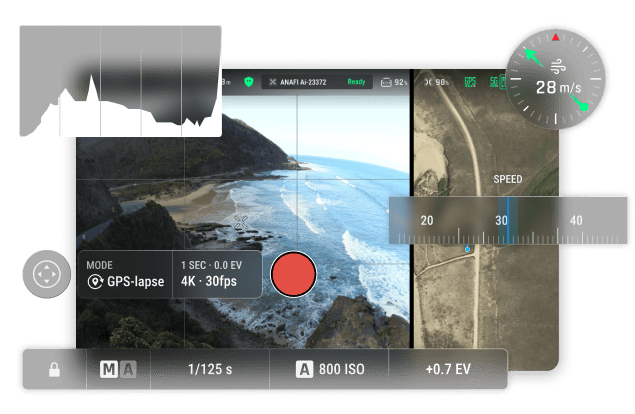
FreeFlight 3, the beginning of sophistication
Version 3 of the application was the first to marked Parrot's shift towards more advanced uses. A true software-platform, the application was dedicated to the piloting of several Parrot drones, both aerial and terrestrial: Bebop, Jumping Sumo and Rolling Spider. It was therefore a challenge to design a modular and dynamic application, with a tactile interface that adapted to the behavior, piloting mode and functionalities of each drone.
This version of the application was unique at the time of its market launch, and set the standard for the consumer drone industry that grew up in the following years.
This version of the application was unique at the time of its market launch, and set the standard for the consumer drone industry that grew up in the following years.
Two interfaces in one
The FreeFlight control screen is both a quadricopter pilot interface and a professional camera interface. On the one hand, this required a major design effort to provide maximum user comfort and action power on a 3.5" touchscreen; on the other, it enabled the NoDesign team to put into practice their passions and skills around aviation, photography and filmmaking. New innovative and simple functions have been designed to enrich the use of the Bebop drone: Director Mode, Flight Plan, Cameraman, FollowMe.
The launch of the ANAFI drone definitively marked the transformation of Parrot drones into truly versatile flying cameras. ANAFI is a light and agile drone whose ease of use must be transmitted through its interface. Hobbyists can use the automatic imaging features to produced beautiful images and videos while focusing on their flight. But professional photographers also need full control to produce exactly the images they need.

NoDesign worked with Parrot teams to produce a powerful yet easy-to-use image control interface that can be used quickly and easily during a flight.
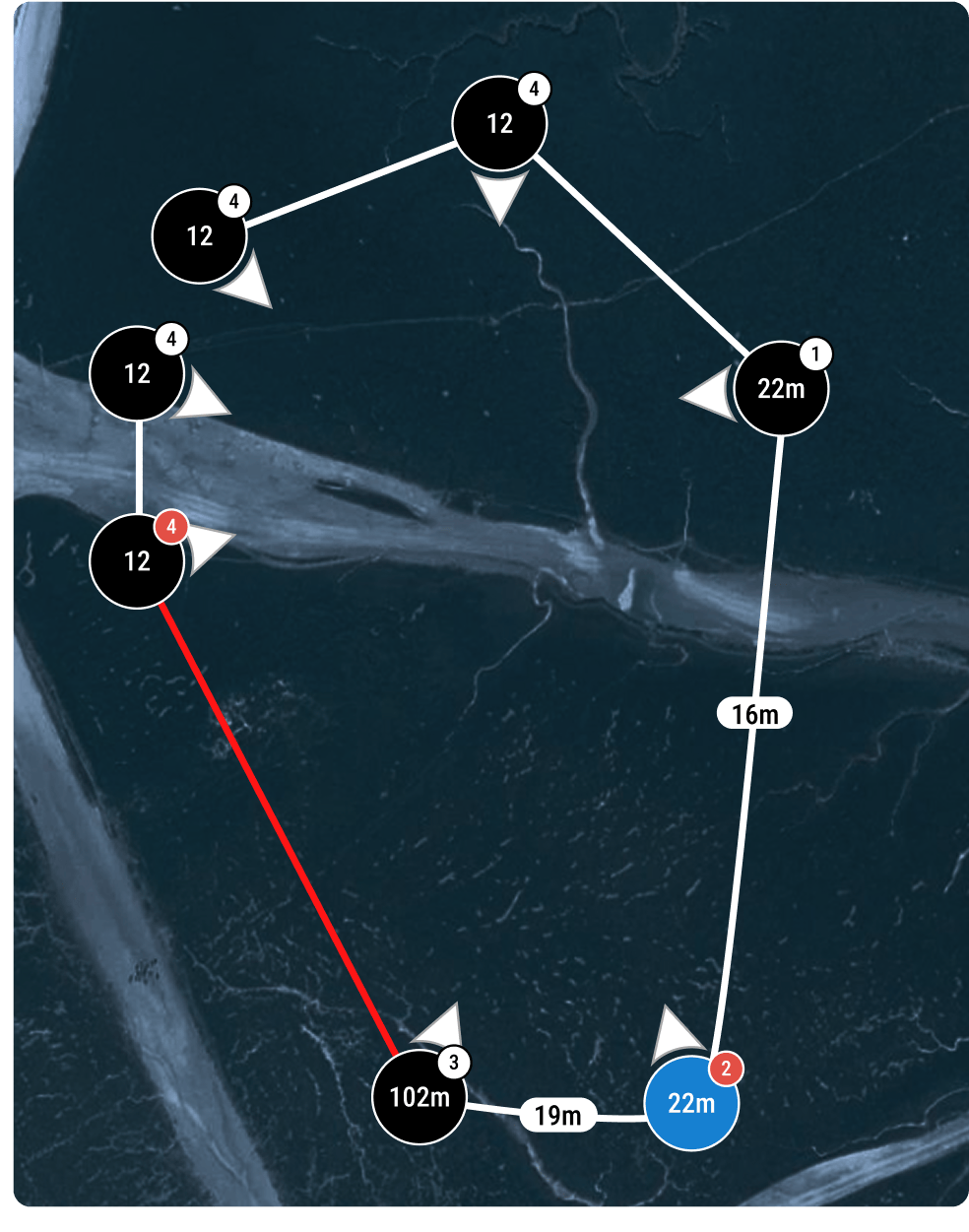
Flight Plan, Programming a flying camera on your smartphone
The FlightPlan feature of the Parrot FreeFlight app allows users to plan automatic flights by defining desired waypoints on a map, an orientation, camera tilt, and speed between two points.
With FlightPlan, users can define a route that the drone will automatically follow. This is particularly useful for missions requiring precision and repetition, such as surveillance, inspection, or mapping.
With FlightPlan, users can define a route that the drone will automatically follow. This is particularly useful for missions requiring precision and repetition, such as surveillance, inspection, or mapping.

Follow Me, teaching a machine to make great footage
Until the 2010s, creating an aerial cinematic shot required large expert teams and a lot of coordination. Since the advent of camera drones, two professionals—a pilot and a cameraman—can now produce cinematic-quality aerial shots. For FreeFlight 6, the ambition was to allow an untrained individual to produce high-quality shots alone. This is made possible by assisted piloting features such as Follow Me and Cameraman piloting modes, allowing one to avoid piloting and the other to frame the shot.
These features allow you to capture the best moments through the use of neural network visual recognition technologies coupled with GPS tracking. You can now, by simply selecting from the streaming image, set yourself as a target to follow, put your smartphone in your pocket and let the drone film your every move in complete autonomy.
These features allow you to capture the best moments through the use of neural network visual recognition technologies coupled with GPS tracking. You can now, by simply selecting from the streaming image, set yourself as a target to follow, put your smartphone in your pocket and let the drone film your every move in complete autonomy.
The user can trigger pre-recorded and configurable movements at any time, allowing them to capture exceptional video footage that would be virtually impossible for a human to achieve alone.
What is a beautiful image? It is from this philosophical question that NoDesign conducted a preliminary study to help Parrot engineers instill the knowledge of cinematic framing into the drone's piloting algorithms.
Finally, it was necessary to imagine an interface without established references to organize all the functions and automatic modes so that they are both accessible and quickly understandable. To do this, NoDesign produced function design videos to prefigure the use of these functions in a real context and share a common vision with the Parrot teams.
What is a beautiful image? It is from this philosophical question that NoDesign conducted a preliminary study to help Parrot engineers instill the knowledge of cinematic framing into the drone's piloting algorithms.
Finally, it was necessary to imagine an interface without established references to organize all the functions and automatic modes so that they are both accessible and quickly understandable. To do this, NoDesign produced function design videos to prefigure the use of these functions in a real context and share a common vision with the Parrot teams.
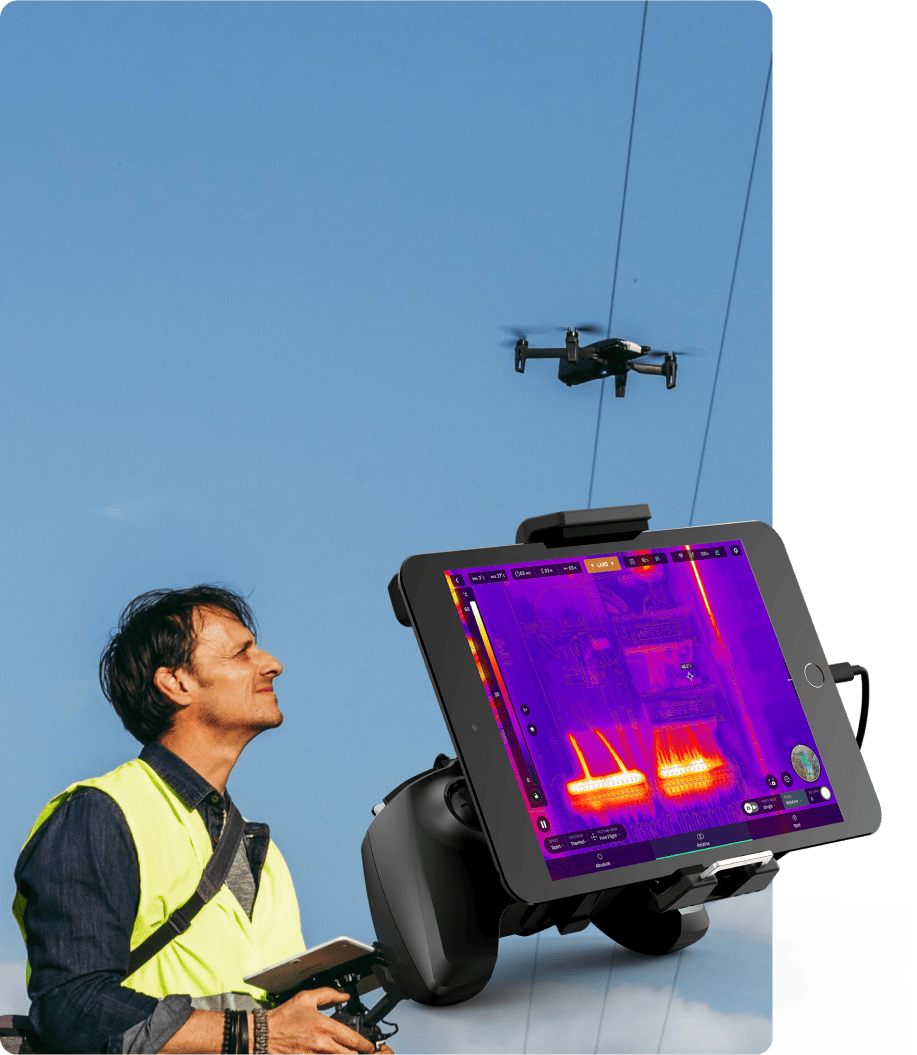
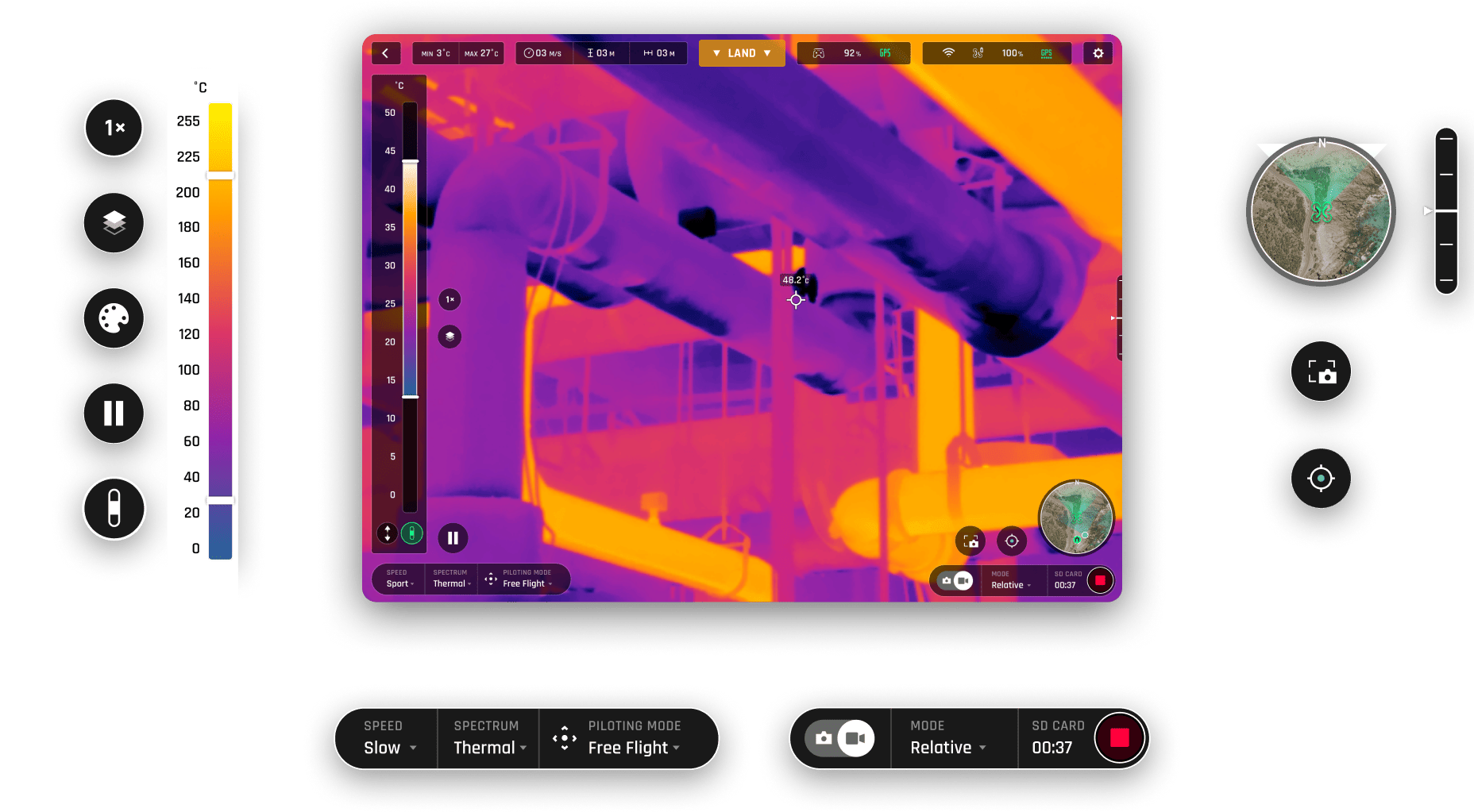
Thermal Vision, a professional thermal imaging camera for everyone.
FreeFlight version 5 introduced thermal imaging for Parrot drones, allowing users to carry out surveillance and inspection missions with precision. By adding a professional thermal imaging camera, we wanted to maintain the simplicity and accessibility of FreeFlight, a proven experience. We therefore made the application as simple and understandable as possible so that someone untrained in thermal imaging can get the information they need quickly and without friction. We have made using the thermal camera as simple and intuitive as piloting it, to ensure maximum performance even under stressful conditions, especially during a firefighting intervention.
FPV flight
Parrot was one of the first manufacturers to offer a first-person view (FPV) drone piloting interface with a digital radio link. This interface allows pilots to see directly through a headset from the drone's perspective, providing precise control and ease of navigation in complex environments.
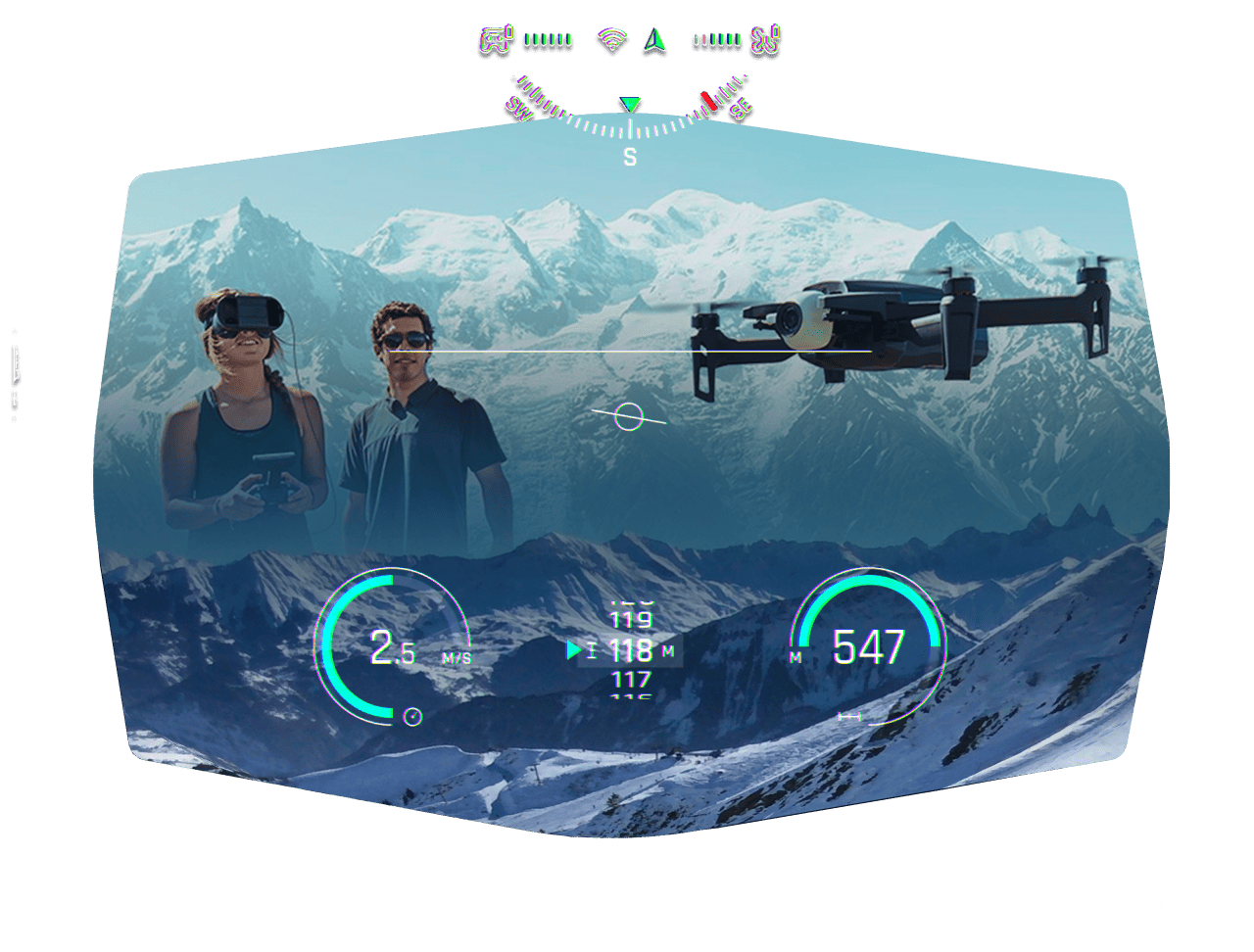
However, several technical and ergonomic challenges must be overcome, particularly to enable prolonged use without discomfort. In the case of Parrot headsets, the hardware interface is created by inserting the smartphone inside a headset equipped with special optics that enlarge the phone's 4" touchscreen and transform it into a stereoscopic view.
The final available resolution is therefore limited, and the interface design must maximize the available pixels and the rendering degraded by such optical zoom.
The final available resolution is therefore limited, and the interface design must maximize the available pixels and the rendering degraded by such optical zoom.
Explicit obstacle detection
The obstacle detection feature with explicit display in Parrot's FreeFlight 7 app is a striking example of hardware and software technological innovation. Using advanced stereoscopic sensors, the ANAFI Ai drone identifies obstacles in its environment in real time and displays them as voxels in an occupancy grid, accurately showing the cluttered areas around the drone.
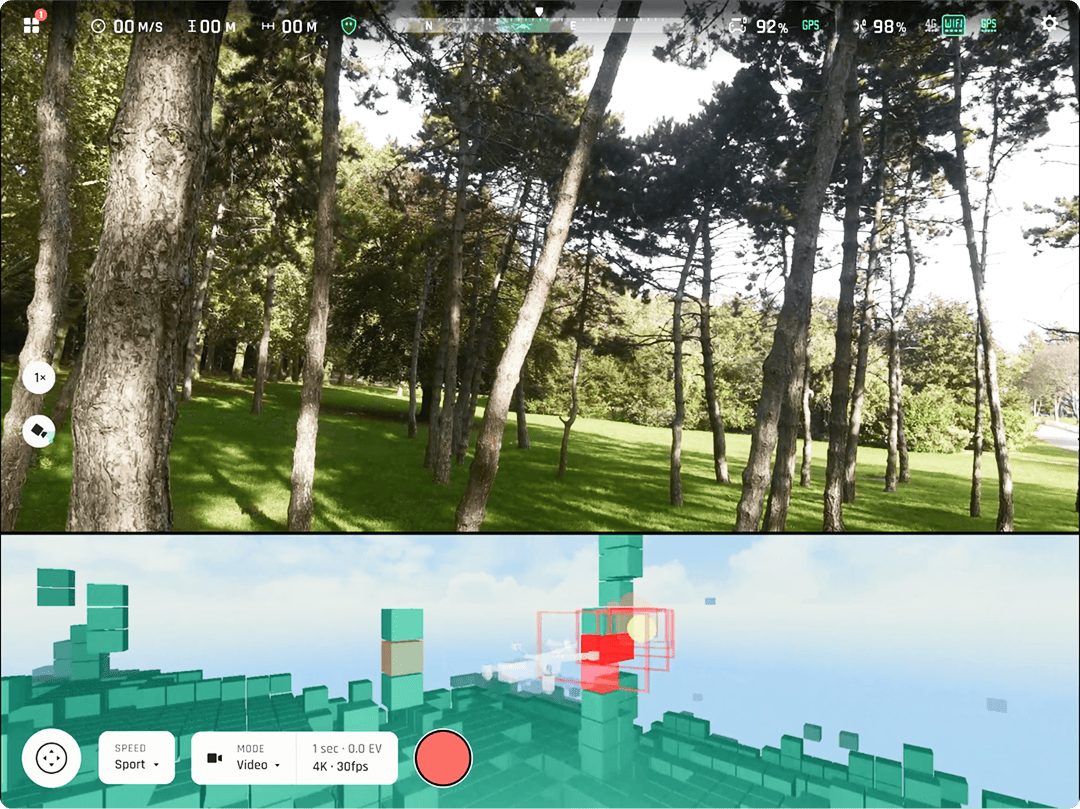
This third-person view allows pilots to plan their flight while avoiding potential collisions, thus making the flight safer. The intuitive user interface makes this feature easy to understand and use, as it not only shows the current position of the drone but also the trajectory of the next 4-5 seconds of flight. This explicit UI allows the user to have a better perception of the flight envelope and stay in the decision-making loop during a manual flight.
Flight Director: AI-powered video editing
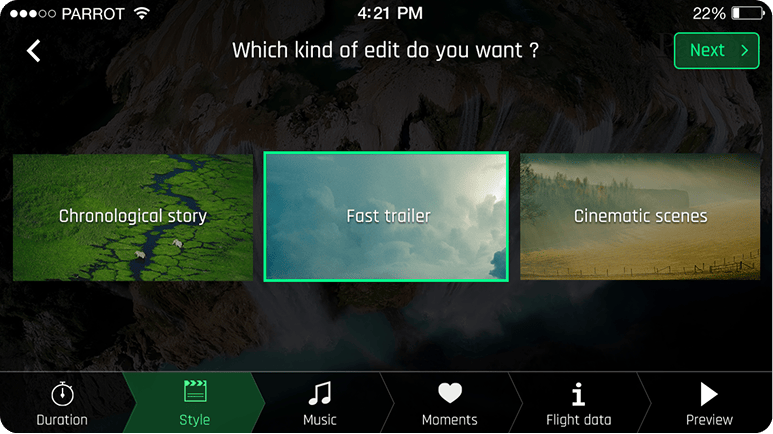
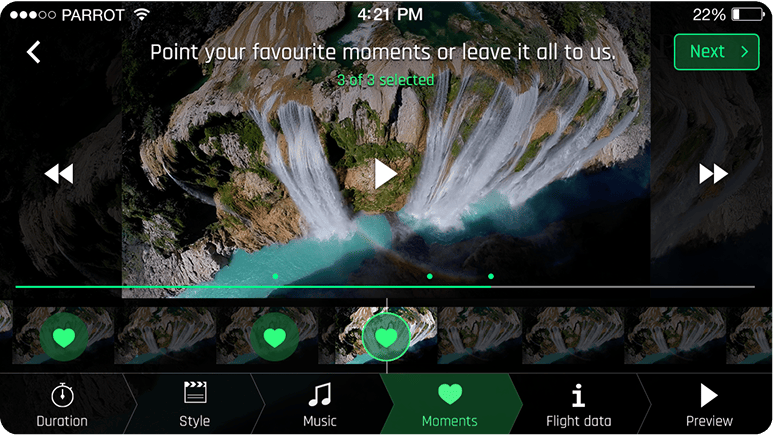
Flight Director's automatic editing feature allows users to create captivating videos from their aerial footage with minimal effort. Using advanced algorithms and AI, this feature analyzes drone behavior and footage and automatically identifies optimal sequences, stitching them together into a video ready for publication. Users can choose from different editing styles (timeline, cinematic, trailer) and add background music to personalize their video. This feature saves time and allows them to focus more on flying and less on editing.
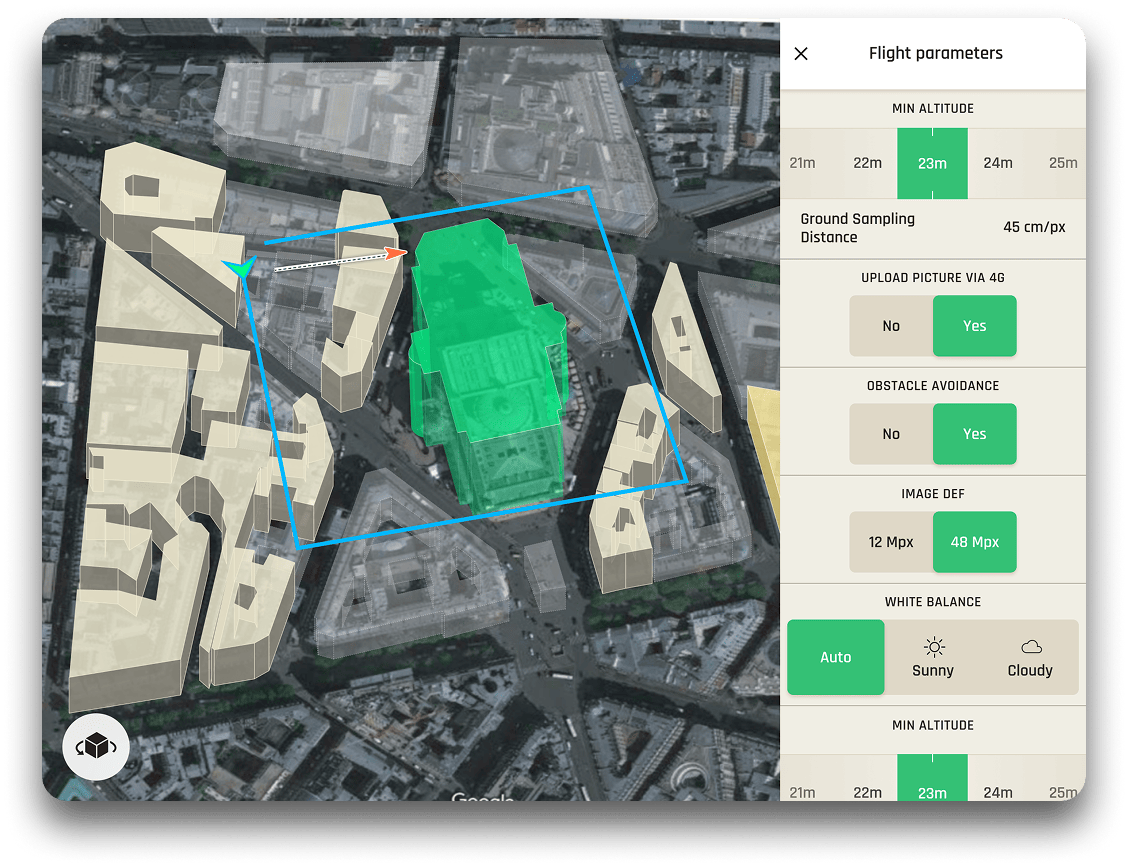
Photogrammetry, aerial 3D scanning by AI
The Photogrammetry feature, introduced with FreeFlight 7, allows users to create high-quality, accurate 2D maps and 3D models from images captured by their drone. With a goal-oriented interface, users can perform large-scale inspections and mapping with minimal input. FreeFlight 7 integrates photogrammetry-specific flight modes, such as grid, dual-grid, and orbit missions, making flight planning and execution easier. The ANAFI Ai drone's 4G connectivity ensures on-the-fly data transmission for cloud-based processing and 3D model generation.

