Strategic reflection of the future and fuction of School Documentation ans Information Centres (CDIs) in High Schools in the Île de France Region.
A "CDI à terminer" » by its users.
Our project is not to set up a place from idealized scenarios, but to lay down an open scenography that allows the emergence of new uses. This place with open programming is reconfigurable by its users, but especially by its uses.
This undetermined space with stated ambitions that is based on the idea of collaboration, experimentation and adaptation. It is in this post-produced by its users from the main functions identified. This laboratory, workshop, with its instruments and tools allows to adapt the facilities and services to the uses, while giving a spatial tool for programming, and simple reconfiguration of implementation. A space of power, resources and initiatives. The CDI of the future must be a place of "active pedagogy" on the principle of the "integrated class", of a new spatial organization, around a free plan and the invention of new uses. This system allows a great freedom of design independent of the space, it allows to evolve with the place, according to practices and temporalities.
This undetermined space with stated ambitions that is based on the idea of collaboration, experimentation and adaptation. It is in this post-produced by its users from the main functions identified. This laboratory, workshop, with its instruments and tools allows to adapt the facilities and services to the uses, while giving a spatial tool for programming, and simple reconfiguration of implementation. A space of power, resources and initiatives. The CDI of the future must be a place of "active pedagogy" on the principle of the "integrated class", of a new spatial organization, around a free plan and the invention of new uses. This system allows a great freedom of design independent of the space, it allows to evolve with the place, according to practices and temporalities.

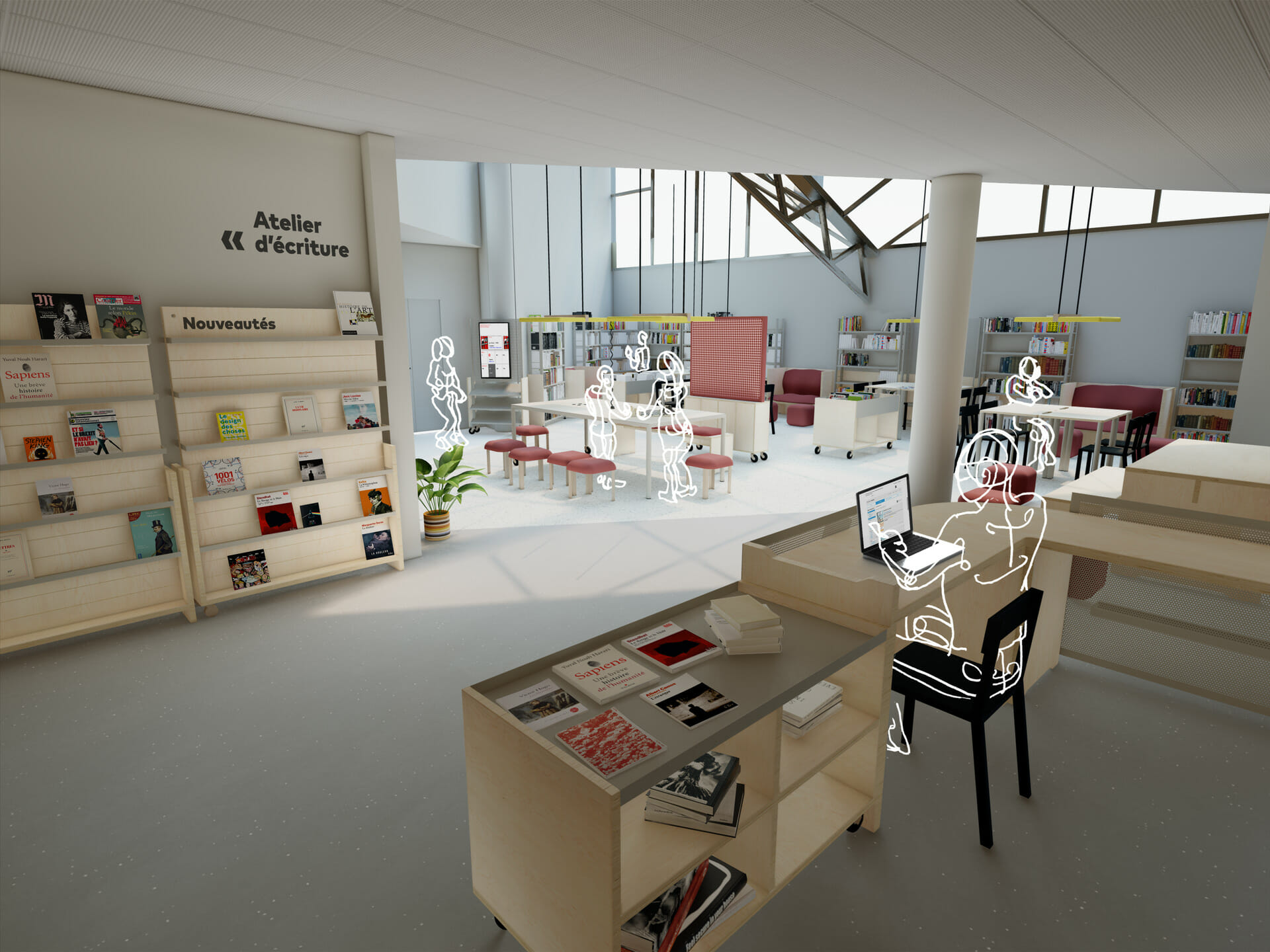
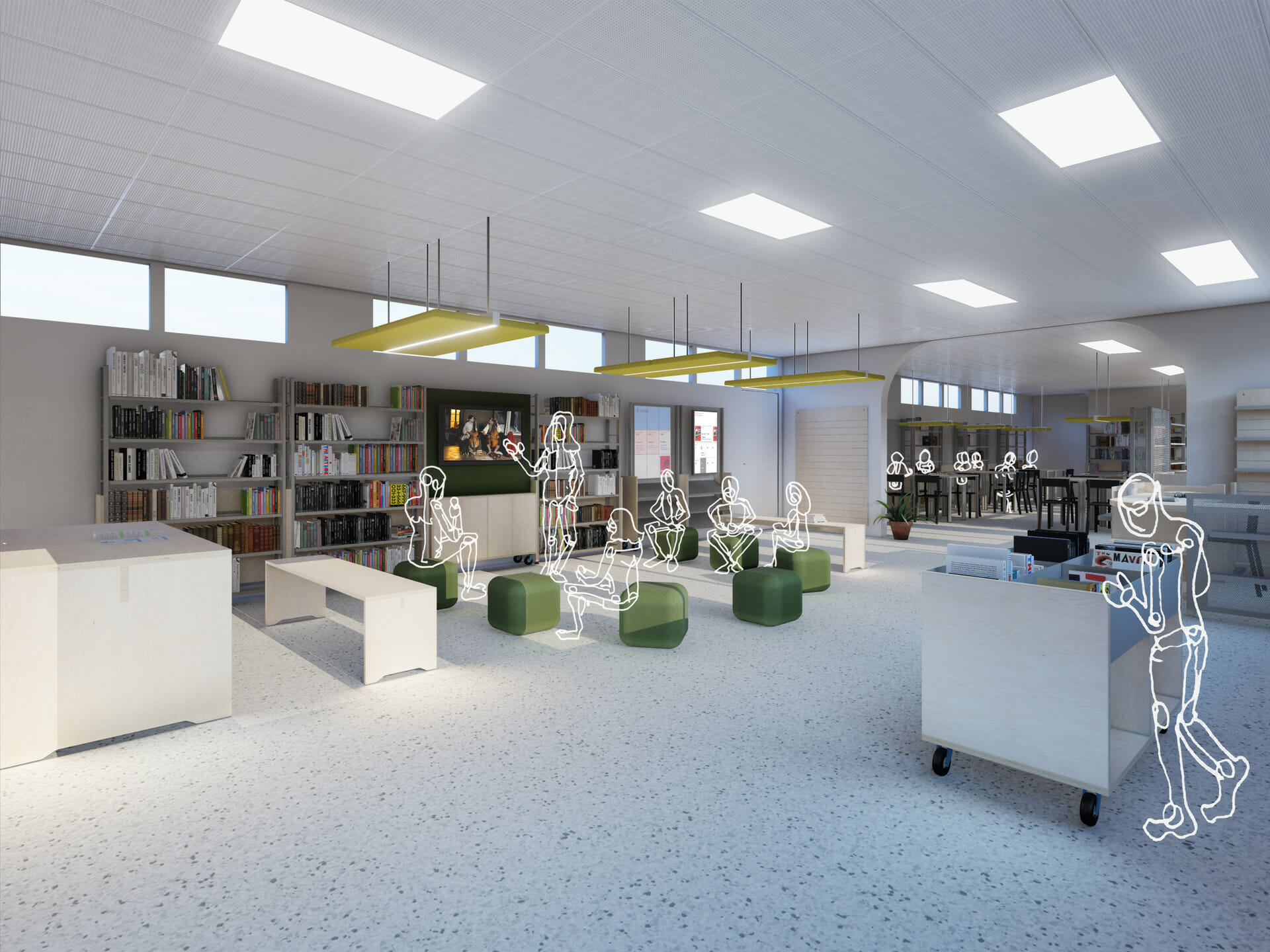
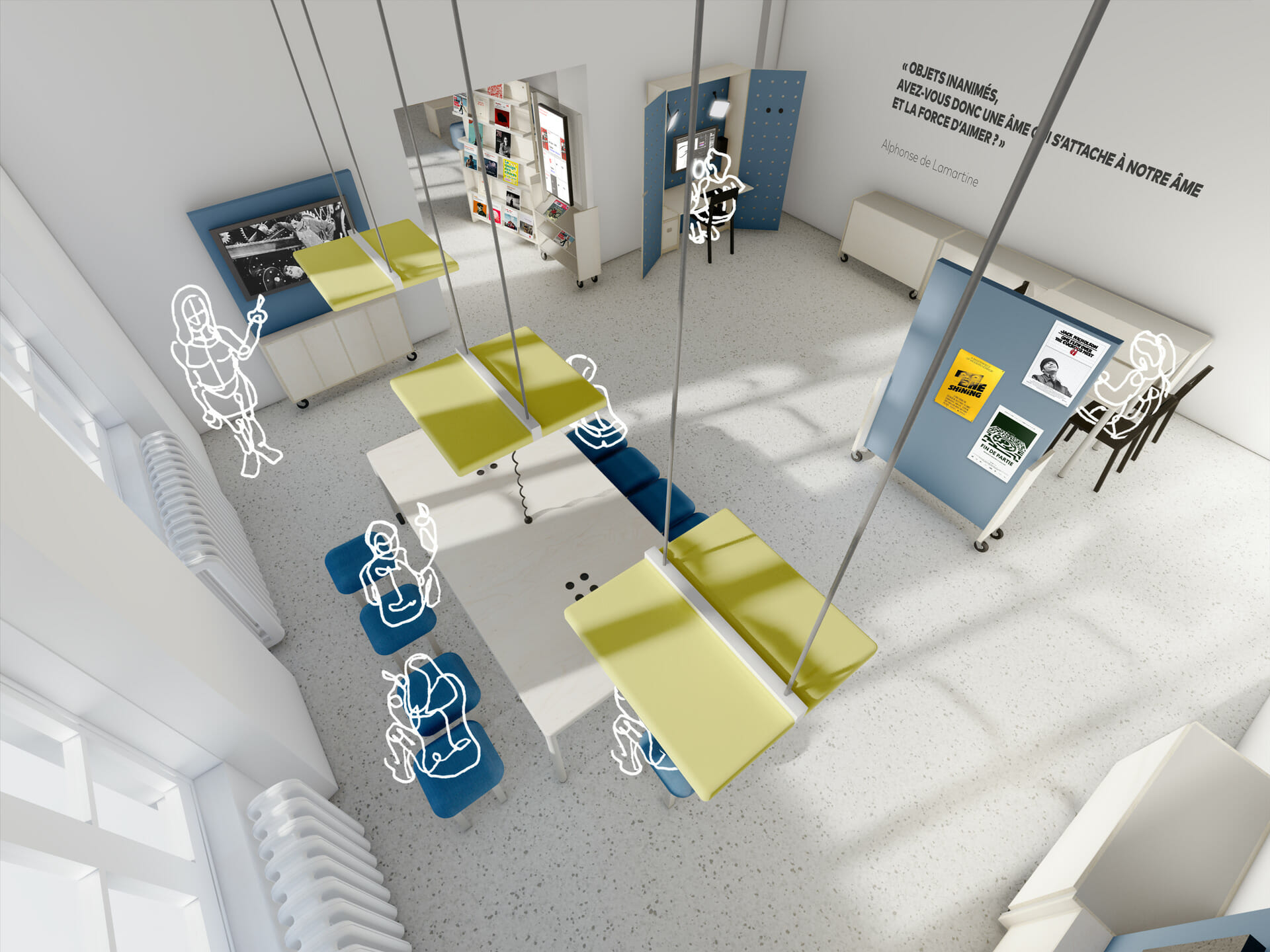
Planning as a tool for experimentation
Our project aims to provide a toolkit for facilitators and users rather than observing their practice."Act and do to understand" is the principle of this project. Our proposal is a structuring furniture system, which changes the layout, uses and practice of the CDI, which changes the relationship to the body, that is to say the posture between the one who knows and the one who listens, in order to feed the project of high schools and the CDI, with a common ambition and specific adaptations. The vocation of our furniture system is to adapt to real uses and initiatives that will come from the ground and accompany the CDI over time. This development process is based on a “Meccano” approach where users and facilitators adapt the tool and space as needed. Method and results are merged, the furniture becomes the trigger of new organization and uses: unallocated furniture, which give power to action to bring up uses . These multifunctional furniture by design, extend the field of possibilities of CDI even outside these walls.

" For a CDI to live, it is essential that the documentalists have a project for the place "
Both system and method
Our project is a system and a method. It is based on a typology of "furniture functions" and a "decoupage" in work areas by functions, moments and situations. The furniture designed on an identical frame, is simple, reconfigurable and multifunctional.
It is also equipped with specific computer equipment that facilitates several practices: collaborative work, discussion, audiovisual production, sound, reading or visual art. This allows the concordance between the uses prescribed by the arrangements and the observed real uses since these are reconfigurable from the most elementary principles possible and structured by large functions. Small partitions with acoustic performances, shelving as separators and furniture "mobile" can allow a harmonious cohabitation of the zones. Our proposal is based on both the functioning and the form, in order to build the future and necessary uses to accompany high school students and promote the teaching framework. The CDI is not limited to being just a "room", it must also be considered as a full-fledged work tool. It is the complement and support of courses and teachers. Functionality, modularity and comfort must therefore be privileged, so that everyone can flourish.
It is also equipped with specific computer equipment that facilitates several practices: collaborative work, discussion, audiovisual production, sound, reading or visual art. This allows the concordance between the uses prescribed by the arrangements and the observed real uses since these are reconfigurable from the most elementary principles possible and structured by large functions. Small partitions with acoustic performances, shelving as separators and furniture "mobile" can allow a harmonious cohabitation of the zones. Our proposal is based on both the functioning and the form, in order to build the future and necessary uses to accompany high school students and promote the teaching framework. The CDI is not limited to being just a "room", it must also be considered as a full-fledged work tool. It is the complement and support of courses and teachers. Functionality, modularity and comfort must therefore be privileged, so that everyone can flourish.
